Nissan Car Repair: Everything You Need to Know About Vehicle Care
Nissan Car Repair Starts With Smart, Routine Care
Nissan car repair includes the routine maintenance and professional inspections that help keep your vehicle safe, dependable, and affordable to own. For Nissan drivers in Cobb County, the best approach is simple: follow your model's maintenance schedule, respond quickly to warning lights or new noises, and use qualified technicians and parts designed to fit your Nissan.
At a glance, Nissan care commonly includes:
- Oil and filter changes based on your owner's manual and driving conditions
- Tire pressure checks each month, tire rotations, and tread inspections
- Brake inspections at least every six months
- Battery, fluid, filter, wiper, and belt checks
- Diagnostic testing for dashboard warnings, unusual smells, vibrations, or sounds
- Recall checks using your vehicle identification number (VIN)
Regular service can catch small concerns before they turn into larger repairs. It also supports fuel economy, tire life, braking performance, and the long-term reliability families expect from Nissan vehicles such as the Rogue, Altima, Pathfinder, LEAF, and ARIYA.
Essential Maintenance and Nissan Car Repair Services
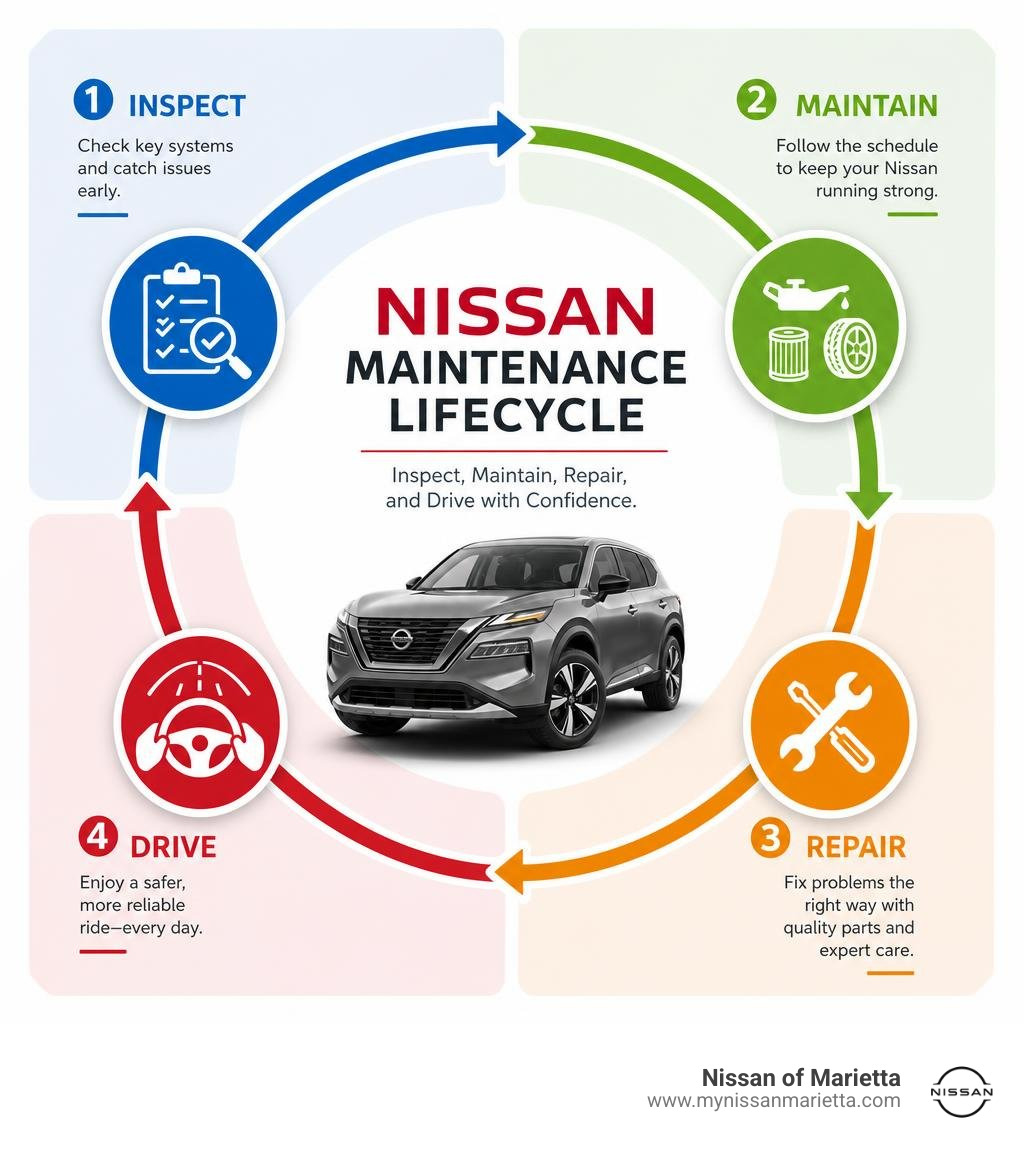
Keeping up with essential maintenance is the single best way to avoid unexpected breakdowns and expensive nissan car repair bills down the road. While modern Nissan vehicles are engineered for high durability, their complex mechanical and electronic systems still require consistent scheduled care.
When you adhere to factory-recommended intervals, you ensure that vital internal components stay clean and lubricated, electronic sensors stay properly calibrated, and safety features function seamlessly. Skipping basic maintenance might seem like a time-saver in the short term, but it almost always leads to premature component wear, reduced engine performance, and lowered resale value.
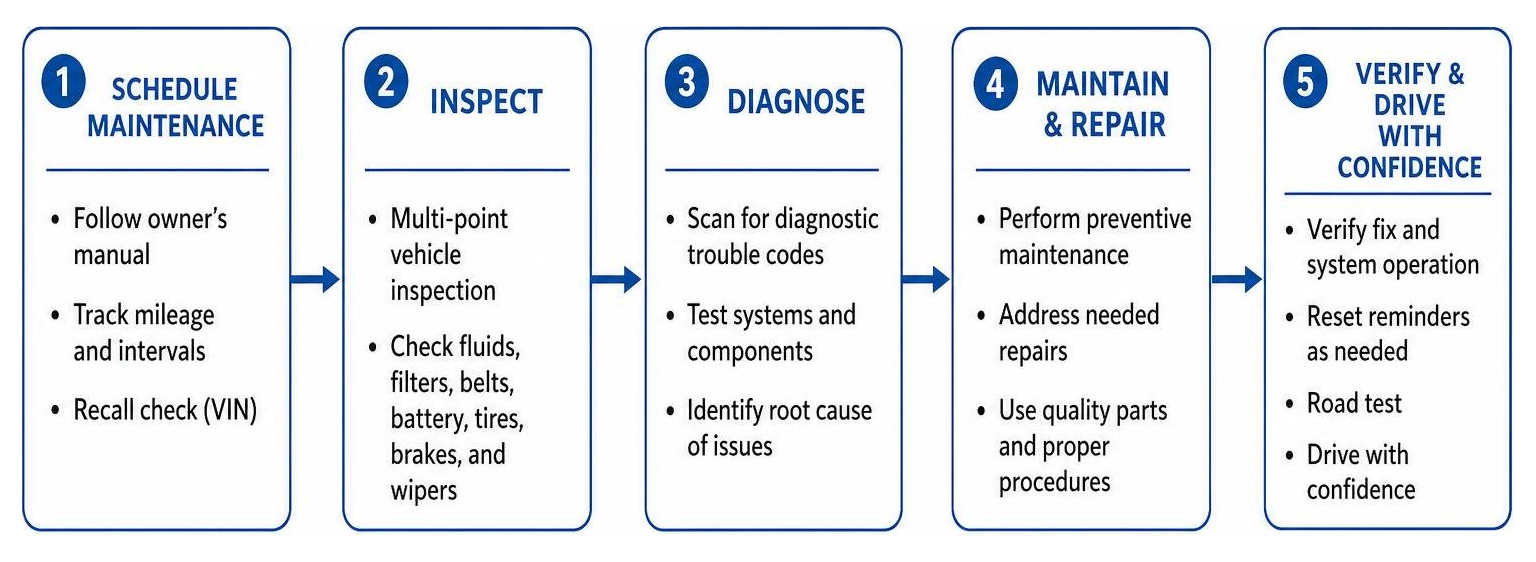
Routine care spans several essential systems:
- Powertrain health (motor oil, filters, drive belts, and cooling systems)
- Chassis stability (tires, suspension alignment, steering linkages, and wheel bearings)
- Safety and stopping power (brake pads, rotors, calipers, and hydraulic fluids)
- Electrical systems (battery health, spark plugs, and computer diagnostics)
To help keep standard maintenance affordable, we frequently offer service promotions like our Service Specials - Oil Change Offer to keep your vehicle running smoothly without stretching your wallet.
Oil Changes and Engine Diagnostic Checks in Nissan Car Repair
Motor oil is the lifeblood of your engine. It reduces friction between moving parts, cools critical internal components, and collects sludge and airborne debris. For modern Nissan cars, trucks, and SUVs, Nissan factory standards explicitly recommend 0W-20 synthetic oil.
Synthetic oil offers exceptional thermal stability, resisting high-temperature breakdown in summer traffic while flowing effortlessly during colder winter mornings. A common myth among drivers is that new engines require a initial "break-in" period using conventional mineral oil before upgrading to synthetic. Nissan engine technology requires zero break-in period for synthetic oil—you can use high-grade synthetic motor oil from day one.
Replacing the oil filter during every single oil change is equally crucial. An oil filter works non-stop to trap microscopic wear metals and dust. If an old filter becomes saturated, dirty engine oil will bypass the filter entirely through a built-in relief valve, recirculating abrasive contaminants directly into your engine's internal bearings.
Modern vehicles also monitor internal health through onboard diagnostic sensors. If your dashboard illuminates a "change engine oil soon" message or a check engine icon, it is important not to ignore it. A active warning light could stem from a simple loose gas cap, or it could signal an engine misfire, evaporative emission leak, or sensor malfunction.
If you notice a sudden illuminated icon on your instrument cluster, explore our Service Specials - Code Check Diagnostic Special to let our certified technicians scan your vehicle's computer systems. You can also read our guide on Blog - Decoding Your Vehicle's Dashboard to quickly identify common dashboard symbols and what actions you should take next.
Tire Rotation, Alignment, and Care Standards
Your tires are the only point of physical contact between your vehicle and the open road, making proper tire upkeep essential for safety, fuel economy, and crisp handling.
Nissan recommends checking your tire inflation pressure at least once a month when the tires are cold (meaning the car has been parked for at least three hours or driven less than one mile). Under-inflated tires increase rolling resistance, which lowers your miles per gallon and causes accelerated wear on the outer shoulder of the tread. Over-inflated tires reduce traction and lead to excessive wear along the center line of the tire.
Tire rotation is another vital maintenance step. On front-wheel-drive models like the Sentra or Altima, the front tires perform steering, acceleration, and the majority of braking forces, causing them to wear down significantly faster than the rear tires. Rotating your tires front-to-back every 5,000 to 7,500 miles ensures balanced tread wear across all four wheels, dramatically extending overall tread life.
When evaluating tread depth, Nissan guidance suggests you begin shopping for new tires once tread wear reaches 4/32 inch. Waiting until tread drops to the legal minimum of 2/32 inch severely compromises stopping distance on wet pavement and increases the risk of hydroplaning during heavy rains.
If it is time for new rubber, check out our dedicated Tire Center and take advantage of seasonal discounts like our Service Specials - Tire Special. For added savings, Nissan offers up to $120 off select sets of tires (valid August 1-31, 2026) alongside a Tire Price Match policy that includes an additional 5% credit on eligible competitor tire quotes.
Understanding Nissan Brake Care and Safety Diagnostics
Stopping power is paramount to driver and passenger safety. Nissan recommends having your entire braking system thoroughly inspected by a qualified technician at least once every 6 months.
Modern brake systems convert kinetic energy into heat using friction between the brake pads and the spinning brake rotor. Over time, friction material naturally wears away. Understanding the physical feedback your vehicle gives you during braking helps you schedule timely service before secondary damage occurs to rotors or calipers.

Recognizing Brake Wear Indicators and Rotor Issues
To prevent drivers from wearing brake pads down to raw metal backings, Nissan designs brake pads with built-in metallic wear indicators. These small steel tabs are precisely positioned to make contact with the rotating rotor when approximately 2 mm of friction material remains. When touched by the spinning disc, the indicator produces a high-pitched squeaking or chirping noise during application. Hearing this sound is a clear signal that your pads need replacement immediately.
Another common complaint is brake pedal pulsation or steering wheel shaking while slowing down from highway speeds. Many drivers assume this feeling is caused by "warped" rotors. In reality, brake rotors rarely warp out of shape. Pedal pulsation is almost always caused by rotor thickness variation—uneven wear spots or uneven friction material transfer across the flat surface of the disc. This unevenness pushes hydraulic fluid back through the caliper line into the brake pedal, creating a noticeable pulse under your foot.
If you suspect your braking system needs attention, check out our article on Blog - Signs You Need Brake Service. Regular brake fluid checks are also essential, as brake fluid absorbs water moisture over time, lowering its boiling point and causing a spongy pedal feel. Browse our current Brake Fluid Flush Service Offer to restore crisp, firm pedal response.
Specialized Brake Care in Professional Nissan Car Repair
Choosing high-quality components and certified service makes a noticeable difference in brake performance and longevity. Genuine OEM Nissan rotors and pads are custom-engineered for specific vehicle weights, heat dissipation traits, and anti-noise characteristics.
When changing worn brake pads, our factory-trained technicians evaluate rotor thickness against precise millimetric minimum specifications. If the rotor maintains adequate thickness and structural integrity, it can be resurfaced (turned) to restore a smooth, flat friction plane. However, if rotor thickness variation is excessive or below safety thresholds, installing fresh, genuine rotors guarantees optimal heat management and short stopping distances.
Maintaining Nissan Electric Vehicles and Powertrains
Electric vehicles (EVs) like the Nissan LEAF and the sleek Nissan ARIYA are popular choices for drivers wanting quiet operation and instant torque. A common question among buyers considering an electric crossover or hatchback is how EV service differs from traditional gasoline-powered cars.
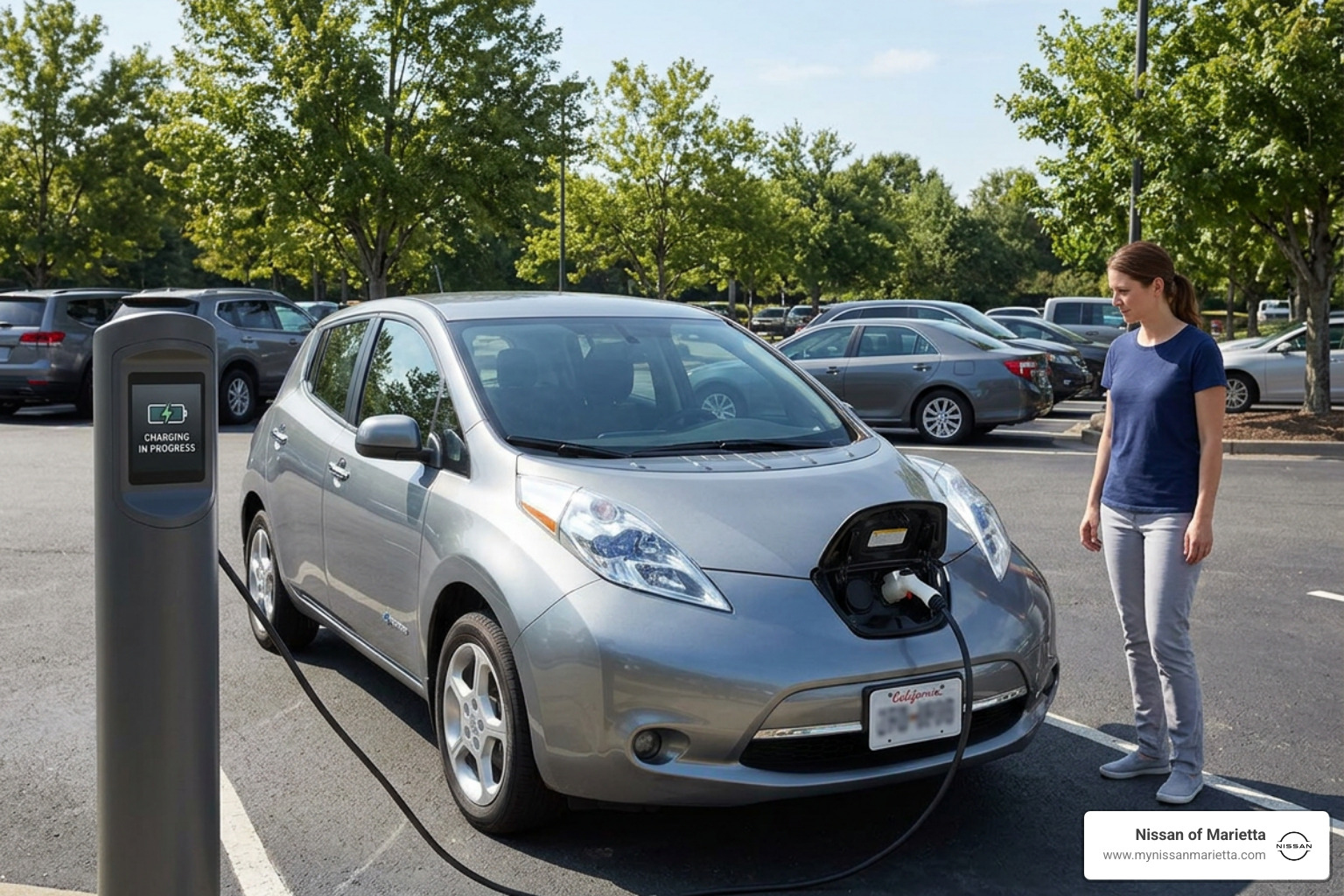
Because EVs lack internal combustion engines, they do not require oil changes, spark plug replacements, air intake filter changes, or drive belt swaps. Exhaust system repairs and starter motor replacements are also eliminated entirely. However, EVs still require key routine care to remain safe and efficient:
- Coolant circuit flushes for high-voltage battery pack climate control
- Brake pad and fluid inspections (though regenerative braking reduces pad wear significantly)
- Tire inflation pressure checks, tread depth checks, and tire rotations due to heavy battery weight and high instant torque
- Cabin micro-filter replacements every 12 months to keep climate control airflow clean
- Windshield wiper blade replacements every 6 months
EV drivers can utilize Level 1 charging (using a standard 120V household outlet for 2 to 5 miles of range per hour) or Level 2 home and public chargers for overnight top-offs. Furthermore, optional NACS adapters give select Nissan EV models access to expansive public fast-charging networks nationwide.
EV Battery Warranty and Care Requirements
The high-voltage lithium-ion battery pack is the central powerhouse of an electric vehicle. Nissan demonstrates strong confidence in its battery engineering by including an extensive 8-year/100,000-mile battery warranty (whichever occurs first) on EV models like the LEAF and ARIYA. This protection guards against capacity loss and manufacturing defect, ensuring long-term peace of mind.
Additionally, Nissan EVs feature 3 years/36,000 miles of Roadside Assistance coverage, supporting you with flat tire support or towing if you run out of charge away from home.
To maximize battery health over time, avoid leaving your EV parked in intense summer heat at a 100% charge for weeks at a time, and utilize scheduled charging timers to top off just before your morning commute. For deeper technical details regarding charging standards and lithium-ion warranty policies, explore the official Nissan FAQ on Service, Maintenance & Repairs - Nissan USA Service & Maintenance.
OEM Parts, Recalls, and Maximizing Fuel Economy
When your vehicle requires component replacements during a nissan car repair, selecting Genuine OEM (Original Equipment Manufacturer) Nissan parts guarantees identical fit, structural finish, and durability to the original factory components. OEM parts are built from factory blueprints and backed by manufacturer warranty support, whereas generic aftermarket parts often rely on approximate universal fits and lower-cost materials.
| Service Factor | Genuine OEM Nissan Parts | Generic Aftermarket Parts |
|---|---|---|
| Engineering Precision | Built to exact factory specs for your specific model | Designed to fit multiple make and model variations |
| Material Quality | High-grade alloys, natural rubber compounds, premium filtration media | Inconsistent material density and cheaper synthetic blends |
| Vehicle Warranty Protection | Preserves full original manufacturer vehicle warranty | May void or complicate specific dealer warranty claims |
| Installation Ease | Direct bolt-on replacement requiring no modifications | May require custom fitting or bracket adjustments |
If you enjoy doing basic garage tasks or need replacement accessories like all-weather floor mats, you can easily Order Parts directly from our dealership inventory.
Strategies to Improve Fuel Efficiency and Performance
Whether you drive a compact Sentra, a midsize Altima, or a 3-row Pathfinder, minor shifts in maintenance habits and driving style yield massive gains at the gas pump:
- Maintain Correct Tire Pressure: Driving on tires under-inflated by just 5 PSI increases rolling resistance and reduces overall fuel economy by up to 2%. Check tire pressure once a month when tires are cold.
- Close Windows at Highway Speeds: Opening windows at speeds over 45 MPH creates severe aerodynamic drag, forcing your engine to burn extra fuel to maintain speed. Rely on your vehicle's climate control system instead.
- Use Cruise Control on Flat Highways: Maintaining steady speed eliminates subtle driver throttle fluctuations, smoothing fuel delivery during long highway trips.
- Replace Saturated Engine Air Filters: Operating in dusty conditions clogs the engine air filter, restricting airflow to the intake manifold and disrupting the air-fuel mixture balance.
- Avoid Extended Engine Idling: Leaving your engine idling burns fuel while producing zero miles per gallon. Turn off your ignition if stopped for more than a minute while waiting outside school or curbside pickup locations.
For extra driving advice and mechanical tips, dive into our detailed guide on Blog - Fuel Efficiency Tips for Nissan Drivers.
Managing Open Recalls and Multi-Point Inspections
Safety is a non-negotiable priority for Nissan. Occasionally, safety recalls are issued by the manufacturer to correct component flaws, software glitches, or structural wear identified through continuous field monitoring. Recall repairs are 100% free of charge to owners when completed at an authorized dealer service center.
Checking for open safety recalls on your vehicle takes less than a minute. Locate your 17-digit Vehicle Identification Number (VIN)—stamped on your registration paperwork or visible on the driver's side lower dashboard glass—and enter it into the recall check tool on the official Nissan Service & Maintenance | Certified Care & Repairs portal. If an active recall is listed, schedule a dealership service appointment right away to have factory-trained technicians perform the remedy.
Every regular service visit at a Nissan dealership includes a complimentary multi-point inspection that checks 27 vital signs across your vehicle. Technicians use a color-coded traffic light system (Green = Good, Yellow = Needs Attention Soon, Red = Requires Immediate Care) to give you total transparency into your vehicle's health without any sales pressure.
Frequently Asked Questions About Nissan Care
What services are included in a complimentary multi-point inspection?
A complimentary multi-point inspection provides a complete health evaluation of 27 vital vehicle signs. Technicians perform digital battery performance tests, measure tire tread depth across all four tires, check tire inflation pressure, inspect brake pad thickness, and evaluate engine oil, brake fluid, transmission fluid, and engine coolant levels. They also inspect wiper blades, drive belts, exterior lighting, CV boots, and suspension components.
How often should wiper blades and engine oil be replaced?
Windshield wiper blades should be replaced every six months. The natural rubber element deteriorates due to continuous UV sun exposure, heat, and ozone breakdown, causing streaking, chattering, or skipping across the glass. For motor oil, Nissan recommends using 0W-20 synthetic oil changed every 5,000 to 7,500 miles (or every 6 months, whichever comes first), along with a fresh OEM oil filter.
How do I check for open recalls on my Nissan?
You can check for open recalls by retrieving your vehicle’s 17-character Vehicle Identification Number (VIN) from your registration card, insurance document, or driver's side door jamb. Enter the VIN into Nissan's official online service portal or call our dealership service desk directly. If an open recall exists, our factory-trained technicians will fix the issue free of charge using genuine replacement parts.
Conclusion
Taking proactive care of your vehicle through consistent routine maintenance is the proven secret to preventing costly nissan car repair bills down the road. By performing monthly tire pressure checks, changing motor oil and filters at prescribed intervals, addressing illuminated warning lights early, and scheduling 6-month brake inspections, you protect both your family's driving safety and your financial investment.
When it comes to expert service, nobody understands your vehicle better than our factory-trained technicians at Nissan of Marietta. Whether you drive a fuel-efficient Sentra, a versatile Rogue, or an electric ARIYA, our team uses high-tech diagnostic equipment and Genuine OEM Nissan parts to deliver top-tier service.
Ready to give your vehicle the care it deserves? Visit our official Service Specials page today to view our current promotional offers, clip money-saving coupons, and schedule your next service appointment in just a few clicks!