

How to Calculate Your Monthly Payment on a Budget
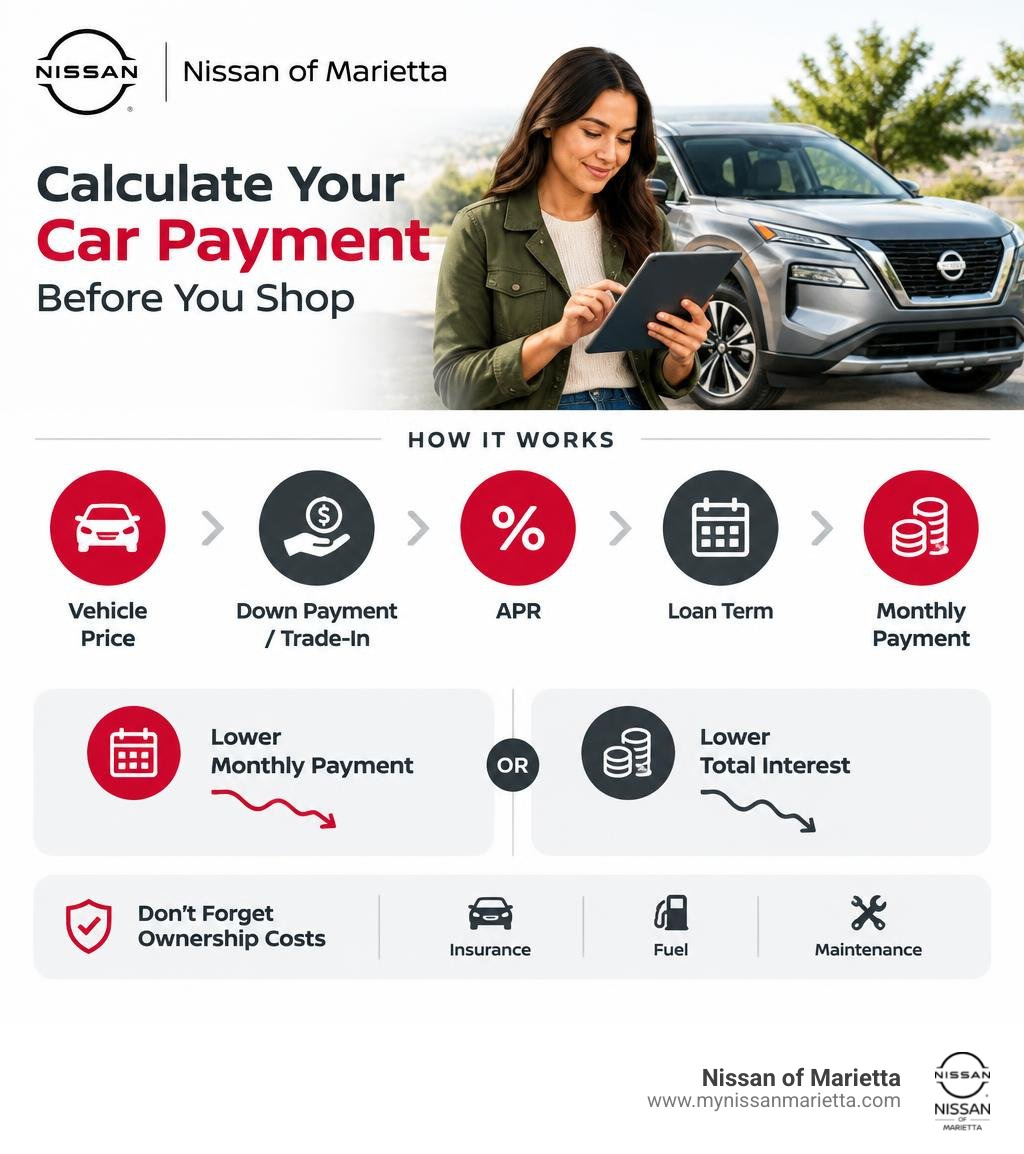
Calculate Your Car Payment Before You Shop
To estimate your monthly car payment, enter the vehicle price, subtract your down payment and any positive trade-in equity, then add taxes and fees you plan to finance. Enter an estimated interest rate and loan term in a payment calculator. Check both the monthly payment and the total interest before changing the term: a longer loan may lower the payment while raising the total cost.
Keep insurance, fuel, and maintenance in your budget, too. They are ownership costs, even if they are not part of the loan payment. That matters whether you are choosing a Nissan for a Marietta commute or more room for family activities in Cobb County.
I'm Vaughn Smith, Marketing Director for Smith Automotive Group. My work in dealership operations and analytics informs how I explain tools like a payment calculator, so you can compare financing choices with a clearer view of the costs.
How an Auto Payment Calculator Works and Core Inputs
An auto loan calculator computes the exact monthly installment required to pay off a loan balance over a designated timeframe at a specific interest rate. It uses an amortization formula where each monthly installment covers both accruing interest and a portion of the original loan balance.
To use an online payment calculator effectively, you must understand how several distinct financial variables interact. The primary elements include the vehicle purchase price, cash down payment, trade equity, interest rate, loan duration, and mandatory government fees such as state sales tax and vehicle registration.

When you finance a car, you borrow the net difference between the total purchase cost and your upfront contributions. If any required taxes or dealer documentation fees are not paid out of pocket at signing, they are rolled into the financed balance, increasing the starting loan balance.
Key Inputs Required for a Payment Calculator
To produce an accurate payment estimate, several core figures must be entered into the calculation tool:
- Vehicle Price: The agreed selling price of the car before additional fees or trade adjustments. Manufacturer MSRP is listed separately from the dealership selling price.
- Down Payment: The upfront cash you invest toward the purchase. A larger down payment reduces the principal amount you borrow.
- Trade-In Equity: The current value of your existing vehicle minus any remaining loan balance. You can easily value your trade to identify whether you have positive equity to apply toward your next purchase.
- Interest Rate or APR: The annualized percentage charged by the lender to finance the vehicle balance.
- Loan Term: The duration of the financing agreement, typically ranging from 36 to 72 months for consumer auto loans.
Tools like the Simple Loan Payment Calculator show that adjusting even one of these variables directly shifts your monthly commitment. For instance, putting down an additional $2,000 in cash lowers the principal immediately, reducing the interest charged every month over the entire loan duration.
Interest Rate vs. APR in Auto Financing
Borrowers frequently treat interest rate and Annual Percentage Rate (APR) as interchangeable terms, but they represent different calculations. Understanding this distinction prevents unexpected financing charges.
The nominal interest rate reflects only the basic cost of borrowing the principal loan balance. It does not account for administrative costs, documentation fees, or prepaid finance charges. In contrast, the APR reflects the total annual cost of credit, bundling the base interest rate along with lender fees and origination costs prorated across the term.
If a financing offer carries zero additional fees or charges, the nominal interest rate and the APR will be identical. When additional lender charges are rolled into the agreement, the APR will be slightly higher than the nominal rate. For a deeper breakdown of credit terms, review our guide to auto financing fundamentals.
The Impact of Loan Term Length on Payments and Total Interest
Choosing a financing duration is a balancing act between monthly budget flexibility and overall borrowing expense. A longer loan term spreads the principal balance over more billing cycles, resulting in a lower monthly installment. However, extending the term keeps the principal balance outstanding longer, which substantially increases the total interest accumulated.
For Cobb County commuters traveling along I-75 or navigating daily routes through Smyrna and Kennesaw, securing a predictable monthly cash flow is essential. However, stretching a loan out to 72 or 84 months simply to achieve an artificially low monthly payment can lead to paying thousands of dollars extra in finance charges over the life of the vehicle.
| Vehicle Price | Interest Rate | Loan Term | Estimated Monthly Payment | Total Interest Paid | Total Loan Cost |
|---|---|---|---|---|---|
| $15,000 | 6.0% | 36 Months | $456 | $1,428 | $16,428 |
| $15,000 | 6.0% | 60 Months | $290 | $2,400 | $17,400 |
| $15,000 | 8.0% | 60 Months | $304 | $3,249 | $18,249 |
| $35,000 | 5.0% | 36 Months | $1,048.98 | $2,763.33 | $37,763.33 |
| $35,000 | 5.0% | 60 Months | $660.49 | $4,629.59 | $39,629.59 |
As shown above, a $35,000 vehicle financed over 36 months requires a payment of $1,048.98 per month with $2,763.33 in total interest. Extending that same loan to 60 months drops the payment to $660.49 per month, but the total interest charges jump to $4,629.59. That represents an extra $1,866.26 paid solely in financing costs. A lower monthly payment does not mean a lower total purchase cost.
Comparing Loan Scenarios with a Payment Calculator
Testing diverse financing scenarios side by side helps you locate the ideal balance between monthly out-of-pocket expenses and long-term interest costs. A mathematical comparison shows the difference across various loan lengths and borrowing amounts.
For example, on a $50,000 loan at a 7% interest rate, a 10-year term produces a monthly payment of $580.54 and total interest of $19,665.09. Extending that same $50,000 loan to a 20-year term drops the monthly payment to $387.65, but total interest charges surge to $43,035.87. Choosing the shorter 10-year term saves over $23,000 in total interest charges.
On smaller balances, such as a $10,000 balance at 12.5% interest, a 3-year term requires a monthly payment of $334.54 with $2,043.31 in total interest. Moving to a 5-year term lowers the payment to $224.98 per month, but increases total interest to $3,498.76, costing nearly $1,500 more over time.
You can explore your borrowing potential with real interest estimates by pre-qualifying online with Capital One before visiting the showroom.
Understanding Your Amortization Schedule and Extra Payments
An amortization schedule is a complete table outlining each periodic payment over the life of a loan. In the early stages of a standard auto loan, a larger share of each monthly payment goes toward accrued interest, while a smaller share reduces the principal. As the outstanding loan balance decreases over time, less interest accrues each month, allowing an increasing portion of your fixed payment to pay down the principal balance.

Making extra payments early in the loan schedule reduces the principal balance faster, which directly decreases future interest accumulation. For example, on a $20,000 auto loan with a 5-year term at 4.5% interest, adding just $100 extra to the monthly payment reduces total interest from $2,371.62 down to $1,817.59. This saves over $550 in finance charges and retires the loan approximately 12 months ahead of schedule.
You can also evaluate non-traditional payment schedules using a Payment Frequency Calculator. Switching to an accelerated biweekly schedule means making half-payments every two weeks. This results in 26 half-payments per year, the equivalent of 13 full monthly payments, shortening your payoff timeline without placing a large strain on your monthly budget.
Determining Car Affordability and Payment-to-Income Ratios
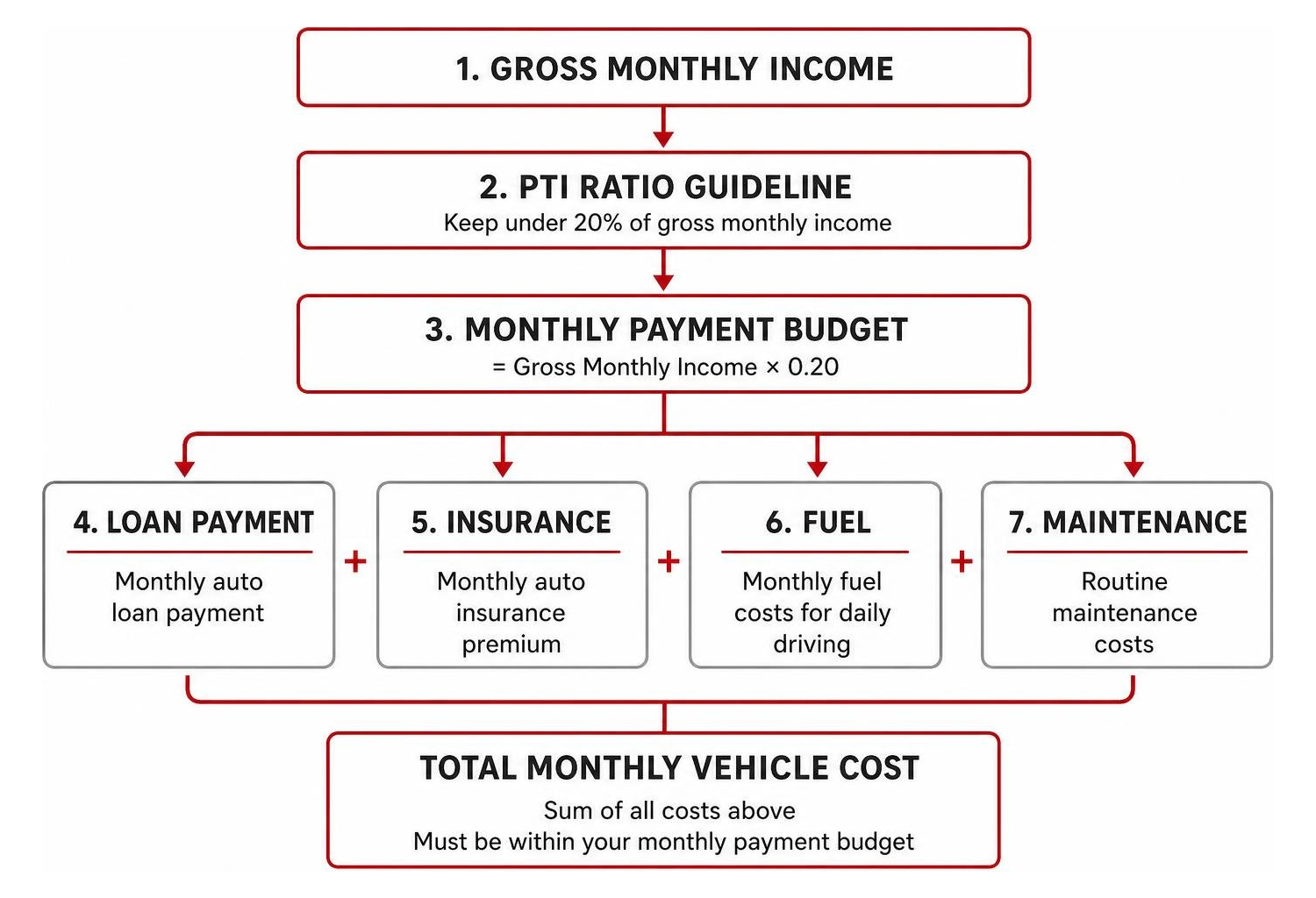
A standard financial guideline in auto financing is maintaining a Payment-to-Income (PTI) ratio under 20% of your gross monthly income. This threshold helps ensure that vehicle payments do not place undue pressure on your other essential financial responsibilities.
When calculating vehicle affordability, account for total ownership costs rather than loan payments alone. Monthly expenses must factor in comprehensive auto insurance, fuel consumption for daily driving around Marietta and East Cobb, and routine maintenance such as oil changes and tire rotations. Factoring in state-specific deductions via a Georgia paycheck deductions tool gives you a clear look at your true net cash flow.
If a new vehicle payment stretches your comfort zone, exploring affordable used cars under $20,000 provides dependable transportation while keeping monthly financing obligations well within healthy budgetary boundaries.
Evaluating Down Payments and Trade-In Equity
The down payment serves as the foundation of vehicle financing. Providing a substantial upfront down payment reduces the total financed principal, lowers monthly payments, and helps shield you from negative equity, a situation where the vehicle's market value falls below the remaining loan balance.
Your existing vehicle can serve as a significant portion of this upfront contribution. Applying positive trade equity directly lowers the financed balance on your next vehicle. You can obtain an instant trade-in offer based on current local market data to see how much equity you have available.
If cash reserves are limited, reviewing down payment assistance programs can help you bridge the gap and structure an affordable loan contract.
What to Do When the Estimated Monthly Payment Exceeds Your Budget
If your calculator results yield a monthly payment that exceeds your target budget, several practical adjustments can bring the numbers into alignment without abandoning your search for a dependable vehicle:
- Extend the Loan Term Modestly: Moving from a 48-month term to a 60-month term lowers the monthly obligation, though you should keep overall interest costs in mind.
- Increase Upfront Capital: Allocating an additional $1,000 to $2,000 toward the down payment reduces the starting balance and monthly installments.
- Explore Certified Pre-Owned Options: Nissan Certified Pre-Owned models provide factory-backed warranty coverage, rigorous multi-point inspections, and modern amenities at a lower price point than brand-new inventory. You can browse our certified inventory to find high-value choices.
- Work with Specialized Lenders: Nissan of Marietta works with many banks specializing in challenged credit and offers customers many financing options. Credit hurdles do not have to halt your search for safe family transportation.
- Utilize Manufacturer Programs: Nissan of Marietta offers competitively priced inventory and Nissan incentives that can make vehicle financing easier. Lower promotional rates substantially reduce both monthly payments and total finance charges.
Reviewing current dealership offers and exploring new vehicle finance specials can provide interest rate reductions that make a significant difference in your final monthly payment.
Frequently Asked Questions about Auto Loan Calculations
Can an auto payment calculator factor in Georgia sales tax and title fees?
Standard online calculators provide an estimate of principal and interest alone. In Georgia, vehicles are subject to the Title Ad Valorem Tax (TAVT), a one-time tax applied to the fair market value of the vehicle at registration, alongside state title and tag fees. To get an exact financed figure, these fees must either be paid upfront at signing or added to the principal balance in the calculator.
How does my credit score affect the interest rate on a car loan?
Lenders use credit scores to evaluate risk. Borrowers with excellent credit scores qualify for lower interest rates, minimizing their monthly payment and overall financing costs. Lower credit tiers typically receive higher interest rates to offset lender risk. For example, on a $15,000 loan over 60 months, an 8% interest rate requires $304 per month ($3,249 total interest), while a 6% rate requires $290 per month ($2,400 total interest).
What is the ideal loan term for a new or used vehicle?
For most car buyers, a loan term between 36 and 60 months offers the best balance of manageable monthly payments and minimal interest charges. Terms extending to 72 or 84 months lower the monthly installment, but they keep you in debt longer and increase the risk of negative equity as the vehicle depreciates.
Conclusion
Calculating your auto loan payment before shopping gives you the information needed to select a vehicle that fits your household finances comfortably. By understanding the relationship between vehicle price, down payment, trade equity, APR, and loan duration, Cobb County drivers can make informed automotive investments without financial guesswork.
Whether you are seeking an efficient sedan for commuting down Cobb Parkway, a versatile crossover for school pickups in Smyrna, or a three-row SUV for family trips across Georgia, our team is here to assist.
Get started today by submitting a secure online finance application or contact the finance team at Nissan of Marietta to discuss tailored loan packages designed around your budget.