What Is the Real Nissan Rogue Gas Mileage in Everyday Driving?
2027 Nissan Rogue e-POWER Hybrid vs. Rogue Gas at a Glance
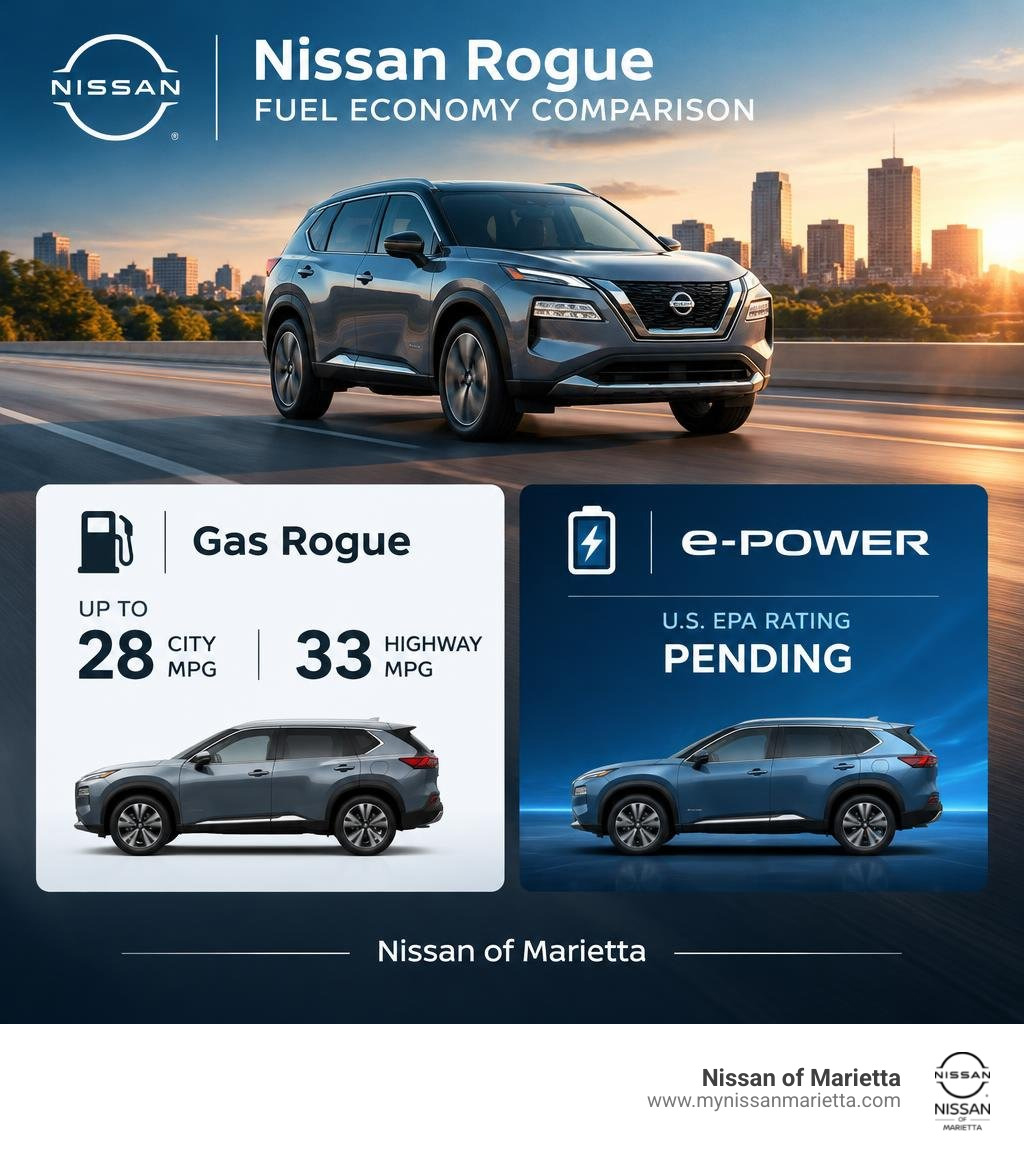
The 2027 Nissan Rogue lineup gives drivers two distinct choices: the innovative Rogue e-POWER series hybrid and the standard 1.5L VC-Turbo gas model (rated at up to 28 mpg city and 33 mpg highway). While official U.S. EPA figures for the e-POWER hybrid await final confirmation, its 100% electric-motor drive is engineered specifically to eliminate city fuel waste through regenerative braking and optimized generator power. Meanwhile, the gas-powered VC-Turbo remains an exceptional long-distance highway cruiser for Cobb County commuters. Explore available Rogue models at Nissan of Marietta.
2027 Nissan Rogue e-POWER Hybrid vs. 2027 Rogue Gas Powertrains
Evaluating the 2027 Nissan Rogue requires understanding how each powertrain generates propulsion and manages fuel consumption. Nissan offers two distinct engineering architectures for 2027: an advanced internal combustion engine (ICE) and an innovative series hybrid system known as e-POWER.
The standard gasoline engine is a 1.5-liter Variable Compression Turbo (VC-Turbo) 3-cylinder engine producing 201 horsepower and 225 lb-ft of torque. The core innovation of the VC-Turbo is its multi-link mechanism that physically alters piston stroke length in real time. Under brisk acceleration, the engine lowers compression to 8:1 for maximum boost, while steady highway cruising raises compression to 14:1 to optimize thermal efficiency.
In contrast, the new 2027 Rogue e-POWER utilizes a series hybrid architecture rather than a conventional parallel hybrid design. In traditional parallel hybrids, both the gas engine and electric motor mechanically turn the wheels. In the Rogue e-POWER, the wheels are driven 100% of the time by high-output electric motors. The onboard 1.5-liter VC-Turbo gas engine never connects to the axles; it functions exclusively as a dedicated generator feeding a high-output battery pack and electric inverter.
| Specification / Metric | 2027 Nissan Rogue 1.5L VC-Turbo (Gas) | 2027 Nissan Rogue e-POWER (Hybrid) |
|---|---|---|
| Powertrain Architecture | Direct-Drive Variable Compression ICE | Series Hybrid (100% Electric Motor Drive) |
| Drive Wheels Propelled By | Gas Engine via Xtronic CVT | Electric Drive Motor(s) |
| Horsepower | 201 hp | Instant Electric Motor Output |
| Torque | 225 lb-ft | High-Response Instant Electric Torque |
| Official EPA Rating | 28 City / 33 Hwy MPG | U.S. EPA Certification Pending |
| Transmission | Xtronic Continuously Variable (CVT) | Single-Speed Direct Electric Drive |
| Efficiency Mechanism | High-compression (14:1) cruising | Decoupled generator RPM & regenerative braking |
Substantiating the Efficiency Difference: Why e-POWER Excels in Town
Although official U.S. EPA numbers for the 2027 Rogue e-POWER are pending confirmation, the mechanical differences explain why each powertrain fits specific driving environments across Marietta, Kennesaw, and Smyrna.
In standard gas engines, stop-and-go driving causes significant efficiency losses due to repeated idling, moving heavy curb weight from a standstill at low gear ratios, and losing forward momentum as friction brake heat. The Rogue e-POWER solves these city penalties through three engineering principles:
- Decoupled Generator Operation: Because the gas engine never drives the wheels, it does not rev up and down with vehicle speed. Instead, engine management runs the 1.5L generator only at its most fuel-efficient RPM range to charge the battery.
- Kinetic Energy Recovery: Every deceleration and braking event uses regenerative braking to capture momentum, converting it back into stored electrical energy rather than wasting it as brake dust and heat.
- Zero-Idle Electric Launch: Electric motors deliver peak torque at zero RPM, providing smooth acceleration from traffic lights without burning excess fuel.
For highway commuters on I-75 and I-285, the standard VC-Turbo gas model remains remarkably efficient because steady-state speeds allow the engine to lock into its 14:1 high-compression ratio. Local shoppers can review electrified lineup options in our 2026 Nissan Rogue Hybrid Showroom and explore other electric hybrid vehicles available at our dealership.
Drivetrain Comparison: FWD vs. Intelligent AWD Efficiency
Drivetrain choice also impacts fuel consumption across both powertrains. Front-wheel drive (FWD) configurations deliver maximum baseline economy by sending power directly to the front axle with minimal rotational friction.
Nissan Intelligent All-Wheel Drive (AWD) provides all-weather grip on wet Georgia roads with minimal fuel impact. An automatic disconnect system sends 100% of driving power forward in dry conditions, engaging the rear axle in milliseconds only when sensors detect slip. Choosing Intelligent AWD generally causes only a 1 mpg difference compared to FWD. Drivers can explore our selection of fuel efficient vehicles in Marietta GA to compare drivetrain configurations.
Gas Mileage Across Rogue Trims: S, SV, Dark Armor, Platinum, and Rock Creek
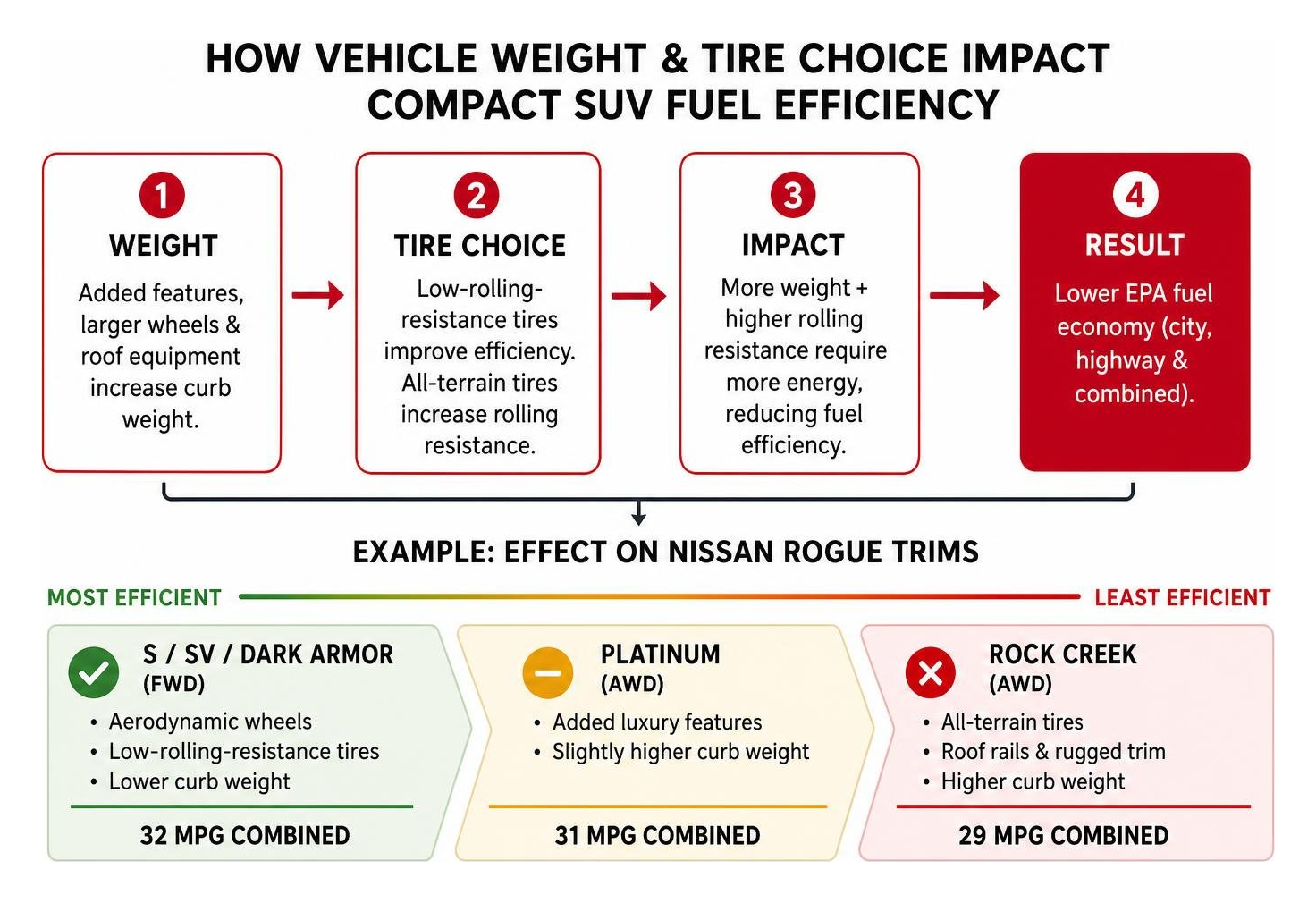
Trim selection impacts real-world and EPA fuel economy through factors such as wheel diameter, tire rolling resistance, curb weight, and exterior aerodynamics. The Rogue lineup includes several well-equipped trims designed for different lifestyles:
- Rogue S and SV: Focus on optimal efficiency, utilizing aerodynamic wheel designs and low-rolling-resistance tires to achieve peak ratings.
- Rogue Dark Armor: Adds striking dark exterior accents, gloss black wheels, and premium cabin technology while maintaining high fuel efficiency. Detailed trim enhancements are outlined in the 2026 Nissan Rogue priced from $28,790, adds striking new Dark Armor grade release.
- Rogue Platinum: Incorporates luxury amenities such as semi-aniline leather-appointed seating, a dual-panel panoramic moonroof, and a Bose premium audio system. These added features slightly increase curb weight.
- Rogue Rock Creek: Features standard Intelligent AWD, all-terrain tires, specialized drive modes, and rugged exterior trim. The higher rolling resistance of all-terrain tires and additional roof rails result in a lower EPA combined rating of 29 mpg.
You can compare trim packages directly in our 2026 Nissan Rogue Showroom to find the right balance of efficiency and style.
Trim-by-Trim Fuel Economy and Equipment Impact
The table below breaks down the EPA fuel economy ratings across the various Nissan Rogue trims and configurations:
| Trim Level | Drivetrain | EPA City MPG | EPA Highway MPG | EPA Combined MPG |
|---|---|---|---|---|
| Rogue S | FWD | 29 | 36 | 32 |
| Rogue SV | FWD | 29 | 36 | 32 |
| Rogue Dark Armor | FWD | 29 | 36 | 32 |
| Rogue SL / Platinum | FWD | 29 | 36 | 32 |
| Rogue S / SV / SL | Intelligent AWD | 28 | 34 | 31 |
| Rogue Platinum | Intelligent AWD | 28 | 34 | 31 |
| Rogue Rock Creek | Intelligent AWD | 27 | 32 | 29 |
| 2027 Rogue (Base Lineup) | FWD / AWD | 28 | 33 | 30 |
For historical context, older models with larger displacement engines delivered lower figures. The 2011 Nissan Rogue Specifications recorded 22 mpg city and 26 mpg highway, while the smaller 2021 Nissan Rogue Sport Specifications achieved 24 mpg city and 30 mpg highway. Full historical data can be reviewed via Nissan Rogue Gas Mileage (2008-2026).
Real-World MPG vs. EPA Estimates and Highway Range
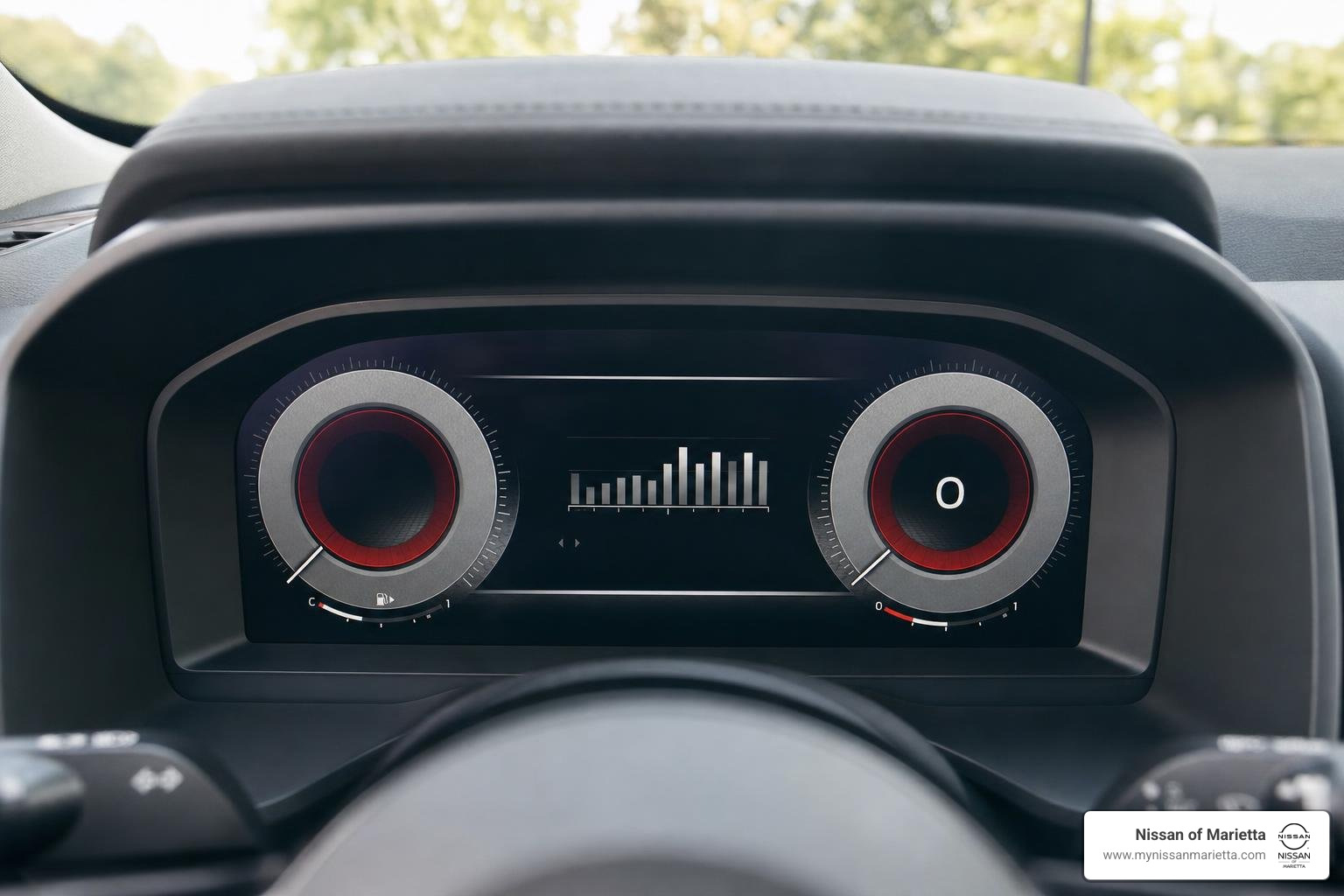
EPA ratings are standardized laboratory measurements designed to provide a fair baseline for vehicle comparison. However, real-world fuel economy is influenced by highway driving speeds, terrain, passenger weight, and local traffic density.
Highway Driving Range and Long-Distance Cruising
The Nissan Rogue features a fuel tank capacity of 14.5 gallons. With an EPA highway rating of up to 34 to 36 mpg on front-wheel-drive models, the Rogue delivers a total highway cruising range of over 490 miles on a single fill-up. Even with a combined rating of 31 mpg on AWD models, drivers can expect an estimated total range of approximately 445 miles.
This extended range reduces fuel stops for Cobb County commuters traveling along I-75 toward Atlanta or heading out on weekend road trips. To learn more about how the Rogue serves local drivers, check out our blog post on why the Rogue is a top SUV choice for Cobb County.
Independent Real-World Testing and Historical Owner Data
Independent evaluations provide helpful insight into high-speed cruising efficiency. In Car and Driver's real-world 75-mph highway fuel-economy test, a Nissan Rogue Platinum AWD recorded 31 mpg. While slightly below its EPA highway rating of 34 mpg, this is typical for high-speed interstate travel where aerodynamic drag increases significantly above 65 mph.
Owner-reported data also demonstrates steady efficiency improvements over time. Aggregated data from 1,991 Rogue owners shows an average real-world fuel economy of 27.8 mpg for recent model years, compared to 21.5 mpg for 2009 models and 24.3 mpg for 2020 models. Detailed technical specifications can be referenced in the 2025 Nissan Rogue Specifications.
Maximizing Efficiency: Drive Modes, Stop-Start, and Fuel Costs
Managing everyday fuel expenses involves combining smart driving habits with the Rogue's built-in efficiency technologies. Estimated monthly fuel costs for a Rogue SV are approximately $173 (based on 15,000 annual miles at standard gas prices), compared to $266 per month for an average midsize SUV. Over five years of ownership, this difference represents substantial savings at the pump.
Drivers can explore our helpful guide on fuel efficiency tips for Nissan drivers to adopt simple driving habits that reduce fuel consumption.
How Driving Habits and Drive Modes Impact Nissan Rogue Gas Mileage
The Nissan Rogue features up to 5 selectable Drive Modes that adjust throttle sensitivity, transmission tuning, and steering feel:
- Auto Mode: The standard setting for daily driving, balancing smooth power delivery with efficient cruising.
- Eco Mode: Optimizes fuel economy by softening throttle response, adjusting climate control draw, and tuning the Xtronic CVT to keep engine RPM low.
- Sport Mode: Sharpens throttle response and holds higher simulated gear ratios for brisk acceleration when merging or passing.
- Snow Mode: Modulates throttle output and optimizes AWD torque distribution to prevent wheel slippage on slick surfaces.
- Off-Road Mode: Available on AWD models and standard on Rock Creek, this mode calibrates throttle response and all-wheel traction for unpaved terrain.
The standard Idle Stop-Start system further cuts unnecessary fuel use by shutting off the engine when stopped at traffic lights along busy corridors like Cobb Parkway, instantly restarting the moment you release the brake pedal.
Nissan Rogue Fuel Economy in Everyday Driving
The combination of the VC-Turbo engine, aerodynamic underbody panels, and intelligent drivetrain management ensures that the Rogue handles daily school drop-offs, grocery trips, and highway commutes efficiently.
Maintenance Disclaimer: The technical and vehicle maintenance information in this article is for educational purposes only. Diagnostic procedures, maintenance work, and mechanical repairs should always be performed by a certified Nissan technician. Please consult the Nissan of Marietta service department and your official vehicle owner's manual before conducting any maintenance or repairs.
Frequently Asked Questions About Nissan Rogue Fuel Economy
What is the difference between the 2027 Rogue e-POWER Hybrid and the standard gas Rogue?
The 2027 Rogue gas model uses a 1.5L VC-Turbo engine to directly drive the wheels through an Xtronic CVT. The 2027 Rogue e-POWER is a series hybrid where electric motors drive the wheels 100% of the time, using the gas engine solely as an onboard generator.
Why is the Rogue e-POWER designed for better city efficiency if EPA ratings are pending?
Because the e-POWER engine runs independently of wheel speed, it operates at peak thermal efficiency while regenerative braking recaptures energy during braking. This avoids the high fuel consumption and idling losses of traditional gas engines in stop-and-go traffic.
What is the official EPA fuel economy rating for the 2027 gas-powered Nissan Rogue?
The 2027 gas-powered Nissan Rogue achieves an official EPA rating of 28 mpg city and 33 mpg highway, resulting in a balanced combined rating of 30 mpg.
How far can a 2027 Nissan Rogue travel on a full tank of fuel?
With a 14.5-gallon fuel tank capacity, a gas-powered Nissan Rogue can travel between 440 and 490 miles on a single tank under steady highway driving conditions.
Does Intelligent AWD significantly reduce the Nissan Rogue's fuel economy?
Nissan Intelligent AWD causes only a modest 1 mpg decrease compared to front-wheel drive because it automatically disconnects the rear axle during steady cruising to conserve fuel.
Conclusion
Choosing between the 2027 Nissan Rogue gas model and the all-new 2027 Rogue e-POWER series hybrid comes down to your daily driving routine. If your week involves highway cruising on I-75, the 1.5L VC-Turbo delivers proven open-road efficiency. If your daily route consists of congested stop-and-go city traffic through Marietta, Smyrna, and Kennesaw, the e-POWER hybrid's electric drive and regenerative braking provide a refined, fuel-conscious solution.
When you are ready to explore your options, our finance specialists provide transparent information regarding purchase price, financing rates, down payment choices, and trade equity. As part of Smith Automotive Group, Nissan of Marietta works with many banks specializing in challenged credit to offer diverse financing plans for every customer.
We invite you to browse our new Nissan Rogue inventory, schedule a test drive, and compare Nissan's latest powertrain technologies in person.